I have been thinking about optimizing input token costs for a while. One way to spend less is to write prompts in a language that splits into fewer tokens. Intuition says that English should be one of the most efficient languages (because it dominated the training data), but what about others? Let`s check. A quick caveat: this is not a rigorous study with statistics over thousands of prompts. It is an informal look at the numbers, based on three texts and fourteen languages.
First of all, I had to decide which models I wanted to research. Nowadays I mostly use Claude AI. Besides, Anthropic provides a rich API, so naturally I decided to test their models.
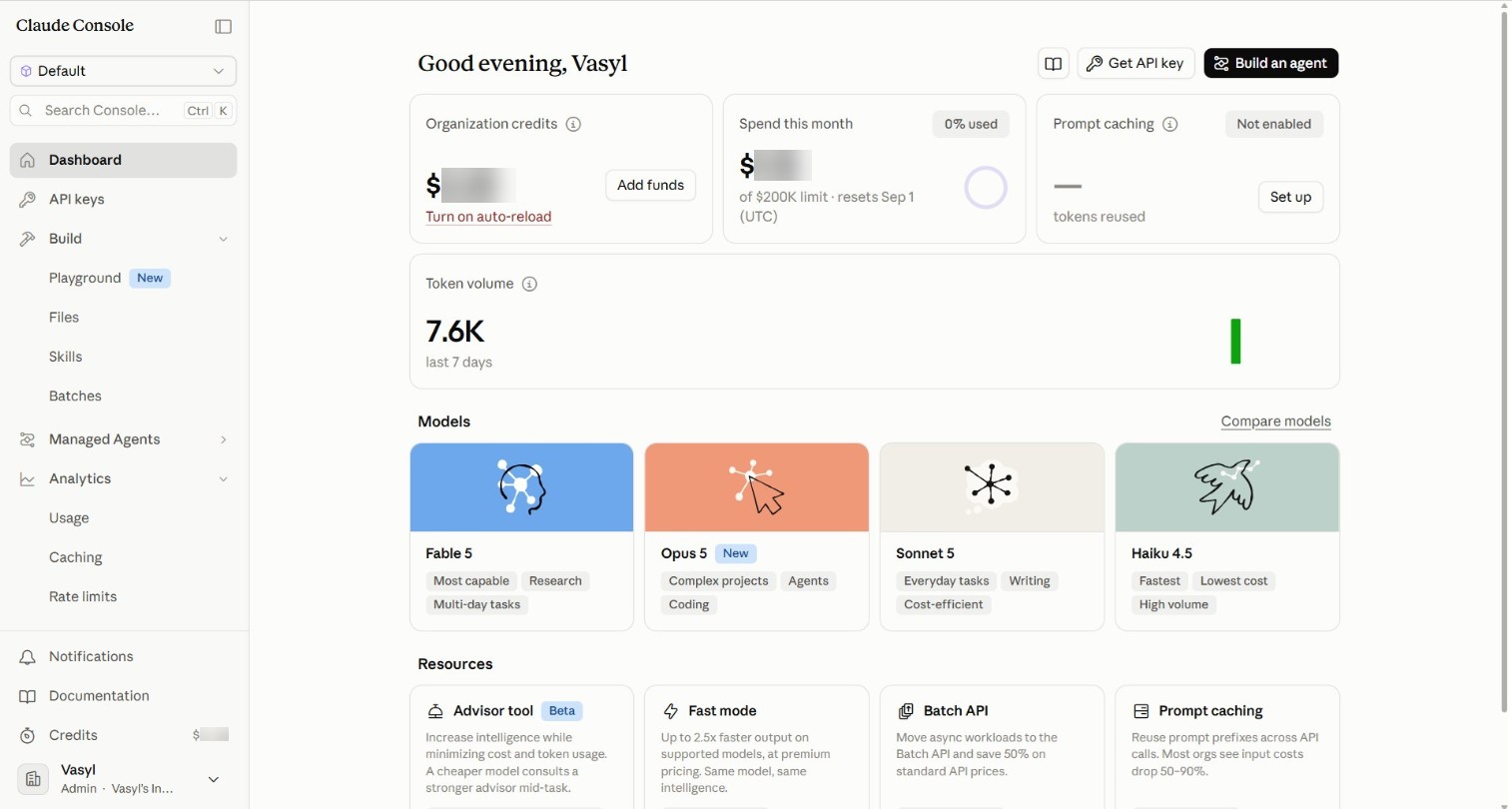
Claude Console UI
Secondly, I had to choose the model itself (Fable, Opus, Sonnet, or Haiku). This decision was not so easy, because I had to grasp what exactly I wanted to measure. My research is based on the assumption that English is the most efficient language to interact with an LLM, and I wanted to know how many more tokens I would spend on a non-English conversation. Obviously, to do that I had to calculate a coefficient for several languages on each model. Therefore, I excluded Fable from the list immediately, because currently it is noticeably more expensive per token. I also excluded Haiku, since I don`t use it very often. In the end, I decided to focus on Opus and Sonnet.
I read that both models of the same generation use the same tokenizer, hence the input token count for Opus 5 and Sonnet 5 should be the same. Let`s verify it anyway.
How exactly did I measure input token count? I built a small console wrapper around Claude API. You can find it on my GitHub and verify my research:
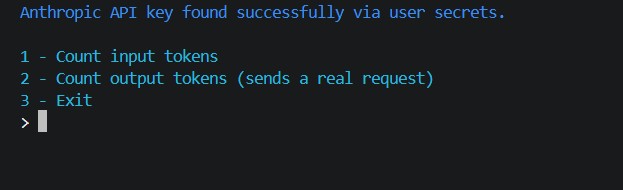
Claude API console wrapper UI
Then I had to create a list of languages I wanted to include. I decided to limit the research to European languages: they cover a wide range of scripts and morphology while remaining comparable in text length. Chinese, Japanese and Korean would have required a separate discussion about the unit of comparison, so I left them out. I grouped European languages into three categories: Latin-script languages with minimal diacritics (English, Dutch, French, German, Italian, Portuguese, Spanish), Latin-script languages with heavy diacritics and/or complex morphology (Czech, Finnish, Hungarian, Polish, Turkish), and languages using a different alphabet (Greek and Ukrainian).
Now let`s look at the prompts themselves. I decided to check three different types: a technical prompt for Claude Design (similar to the one from my earlier article, "Claude Design: A first look"), a literary text, and a typical prompt asking an AI to do something useful. Here they are:
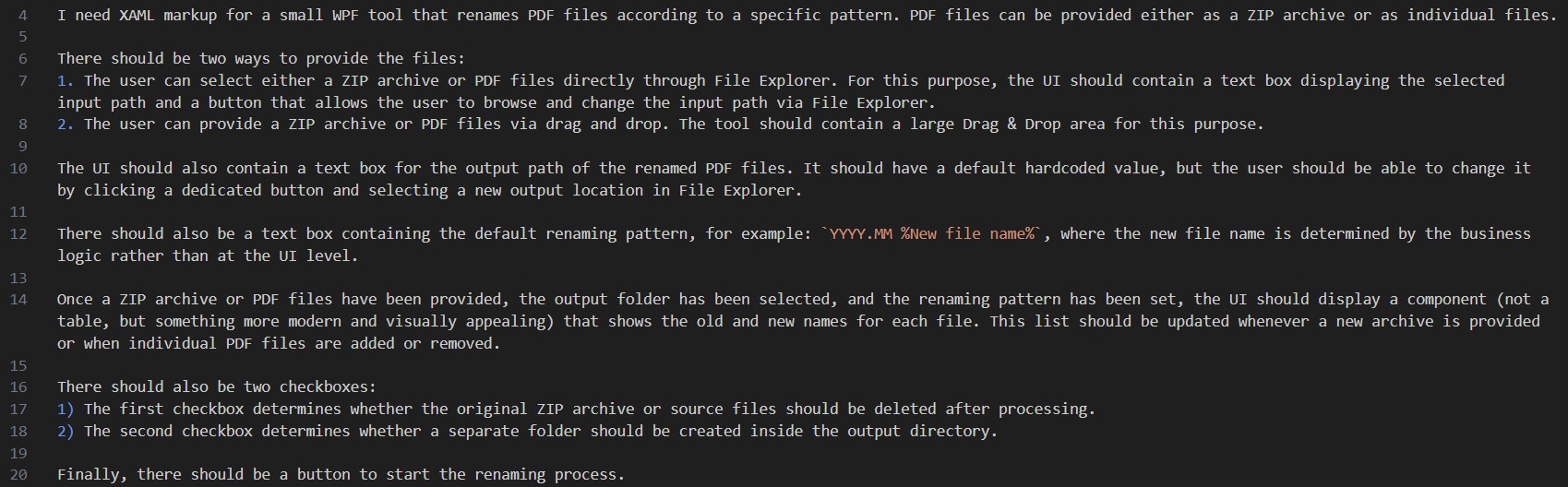
Technical prompt for Claude Design
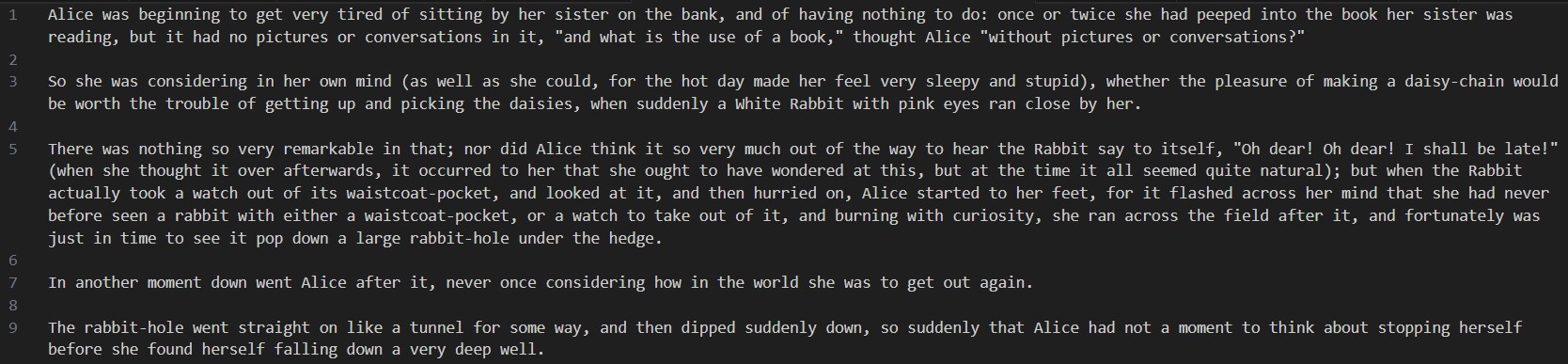
Literary text: first few paragraphs from "Alice`s Adventures in Wonderland"

Prompt asking an AI to plan a Prague trip
The paragraph breaks are shown in the screenshots above only to make the text easier to read. I translated all the prompts into other languages via Google Translate. This affects the results in a couple of ways. Abbreviations in the technical prompt stay the same across all the languages, which should pull the coefficient for this type of text closer to 1. Google Translate also tends to produce literal translations, closely following the structure of the English original. A human translator would phrase things more naturally, and often less predictably. The effect is strongest for the literary text: plenty of human translations exist in each language, but I used machine translation to save time. This likely affects the coefficients, though I did not check in which direction.
And here is an example of measuring the input token count for a prompt in the Anthropic API wrapper:
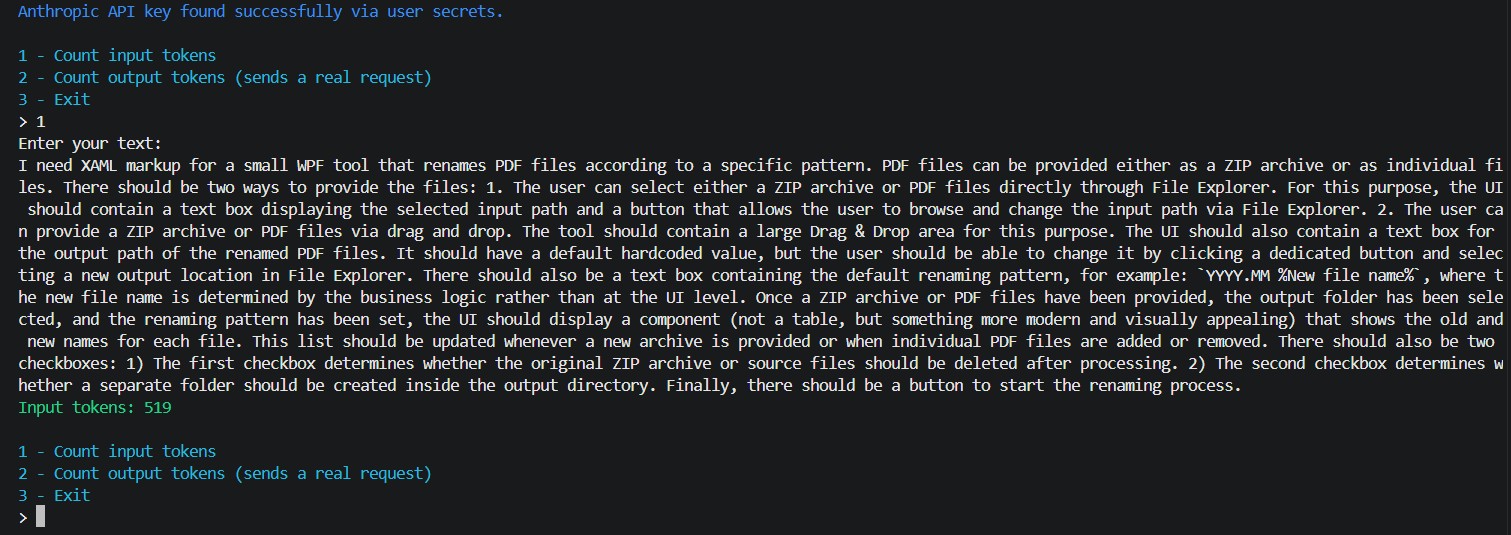
Measuring input token count for the prompt
And a few words about calculating the coefficient. It is quite simple: the ratio of the input token count for a particular language to the token count for English. I assume that in most cases it will be greater than 1. So let`s finally measure it and look at the results for the technical prompt for Claude Design:
| Language | Opus 5/Sonnet 5 | Coefficient |
|---|---|---|
| English | 519 | 1.00 |
| Latin script, minimal diacritics | ||
| Dutch | 902 | 1.74 |
| French | 808 | 1.56 |
| German | 988 | 1.90 |
| Italian | 841 | 1.62 |
| Portuguese | 841 | 1.62 |
| Spanish | 835 | 1.61 |
| Latin script, heavy diacritics and/or rich morphology | ||
| Czech | 946 | 1.82 |
| Finnish | 1053 | 2.03 |
| Hungarian | 995 | 1.92 |
| Polish | 1025 | 1.97 |
| Turkish | 1022 | 1.97 |
| Non-Latin script | ||
| Greek | 1602 | 3.09 |
| Ukrainian | 956 | 1.84 |
The input token count and the coefficient for the Claude Design prompt
The first observation is that the input token count for Opus and Sonnet is the same. No surprises there, since both models use the same tokenizer - but verifying an expected result is still useful. Let`s take a closer look at the numbers.
The first anomaly is, of course, the Greek coefficient: it takes more than three times as many input tokens as English. Ukrainian, at the same time, is just 1.84, even though both Greek and Ukrainian alphabets are non-Latin. It looks like there was much more technical training data in Ukrainian than in Greek. Though there is no way to verify this without knowing the composition of the training data.
The second interesting result is the German coefficient: it is higher than the Czech one, despite all the Czech diacritics. I think this can be explained by the length of German words - compound nouns get split into several tokens more often than Czech ones do. The same assumption probably explains the slightly higher coefficient for Dutch compared to French.
Now the same measurement for the literary text from "Alice`s Adventures in Wonderland":
| Language | Opus 5/Sonnet 5 | Coefficient |
|---|---|---|
| English | 539 | 1.00 |
| Latin script, minimal diacritics | ||
| Dutch | 710 | 1.32 |
| French | 659 | 1.22 |
| German | 782 | 1.45 |
| Italian | 716 | 1.33 |
| Portuguese | 622 | 1.15 |
| Spanish | 703 | 1.30 |
| Latin script, heavy diacritics and/or rich morphology | ||
| Czech | 714 | 1.32 |
| Finnish | 874 | 1.62 |
| Hungarian | 712 | 1.32 |
| Polish | 793 | 1.47 |
| Turkish | 739 | 1.37 |
| Non-Latin script | ||
| Greek | 1162 | 2.16 |
| Ukrainian | 830 | 1.54 |
The input token count and the coefficient for the literary text from "Alice`s Adventures in Wonderland"
All the coefficients for the literary prompt are lower than the ones for the technical prompt. Two of my earlier assumptions did not survive contact with the data. Abbreviations in the technical prompt were supposed to pull its coefficients closer to 1, and a more complex literary text was supposed to produce higher ones. Both turned out to be wrong. Maybe this happened because the technical prompt was full of terms like Checkbox, Drag and Drop, Hardcoded - in translation these either turn into long descriptive phrases or into calques that the tokenizer has rarely seen and splits into several tokens. "Alice", on the other hand, uses common nineteenth-century vocabulary, and on top of that, its translations are physically present in the training data for all these languages. So the main conclusion from this measurement is that the token count depends not only on the language, but to a large extent on the vocabulary as well.
Let`s continue and measure the token count and the coefficient for the everyday prompt:
| Language | Opus 5/Sonnet 5 | Coefficient |
|---|---|---|
| English | 286 | 1.00 |
| Latin script, minimal diacritics | ||
| Dutch | 436 | 1.52 |
| French | 430 | 1.50 |
| German | 492 | 1.72 |
| Italian | 432 | 1.51 |
| Portuguese | 383 | 1.34 |
| Spanish | 424 | 1.48 |
| Latin script, heavy diacritics and/or rich morphology | ||
| Czech | 426 | 1.49 |
| Finnish | 530 | 1.85 |
| Hungarian | 463 | 1.62 |
| Polish | 460 | 1.61 |
| Turkish | 488 | 1.71 |
| Non-Latin script | ||
| Greek | 735 | 2.57 |
| Ukrainian | 482 | 1.69 |
The input token count and the coefficient for the typical user prompt
All the numbers for the typical prompt fall between the two other measurements, without exception. German is again higher than Czech, and Dutch is again higher than French, though this time the difference is much smaller. But the token count for English is about half of what it was in the other measurements, so this measurement is noisier.
Now the final comparison:
| Language | Claude Design prompt | Alice in Wonderland | Travel planning prompt | Arithmetic mean |
|---|---|---|---|---|
| English | 1.00 | 1.00 | 1.00 | 1.00 |
| Latin script, minimal diacritics | ||||
| Dutch | 1.74 | 1.32 | 1.52 | 1.53 |
| French | 1.56 | 1.22 | 1.50 | 1.43 |
| German | 1.90 | 1.45 | 1.72 | 1.69 |
| Italian | 1.62 | 1.33 | 1.51 | 1.49 |
| Portuguese | 1.62 | 1.15 | 1.34 | 1.37 |
| Spanish | 1.61 | 1.30 | 1.48 | 1.46 |
| Latin script, heavy diacritics and/or rich morphology | ||||
| Czech | 1.82 | 1.32 | 1.49 | 1.54 |
| Finnish | 2.03 | 1.62 | 1.85 | 1.83 |
| Hungarian | 1.92 | 1.32 | 1.62 | 1.62 |
| Polish | 1.97 | 1.47 | 1.61 | 1.68 |
| Turkish | 1.97 | 1.37 | 1.71 | 1.68 |
| Non-Latin script | ||||
| Greek | 3.09 | 2.16 | 2.57 | 2.61 |
| Ukrainian | 1.84 | 1.54 | 1.69 | 1.69 |
The final coefficient comparison
So, what did I find? First of all, the coefficient is not really a property of a language. Polish costs 1.47 on the literary text and 1.97 on the technical one - that spread is bigger than the difference between many of the languages in the table. So any "coefficient per language" (including mine) should be read together with the type of text it was measured on.
The order of the three prompts turned out to be the same for all thirteen languages, without a single exception: the literary text is the cheapest, the everyday prompt sits in the middle, and the technical one is the most expensive. My guess is that it all comes down to how often the tokenizer has seen the words before. Translations of "Alice" are physically present in the training data for every language on the list, while "drag and drop" in Finnish is probably a rare guest there.
The alphabet itself matters less than I expected. Greek and Ukrainian are both non-Latin, but Greek costs 2.61 on average and Ukrainian only 1.69. Compound words seem to hurt more than diacritics: German (1.69) is more expensive than Czech (1.54), and inside the "minimal diacritics" group the two compounding languages, German and Dutch, sit above all four Romance ones.
And the practical part. The range goes from 1.37 for Portuguese to 2.61 for Greek, so the advice "just write in English" is worth very different money depending on where you are from: a Portuguese speaker saves about a quarter of the input cost, a Greek one saves more than half. Worth remembering that this covers input tokens only - output tokens cost five times more per token across the current Claude lineup, and the language affects them too.